



The geography of talent: where to find the best candidates for each instrument
Every instrument has its world capitals, its secret nurseries, its migration routes. Ignoring them means fishing in the desert
In this article
The invisible map of string talent
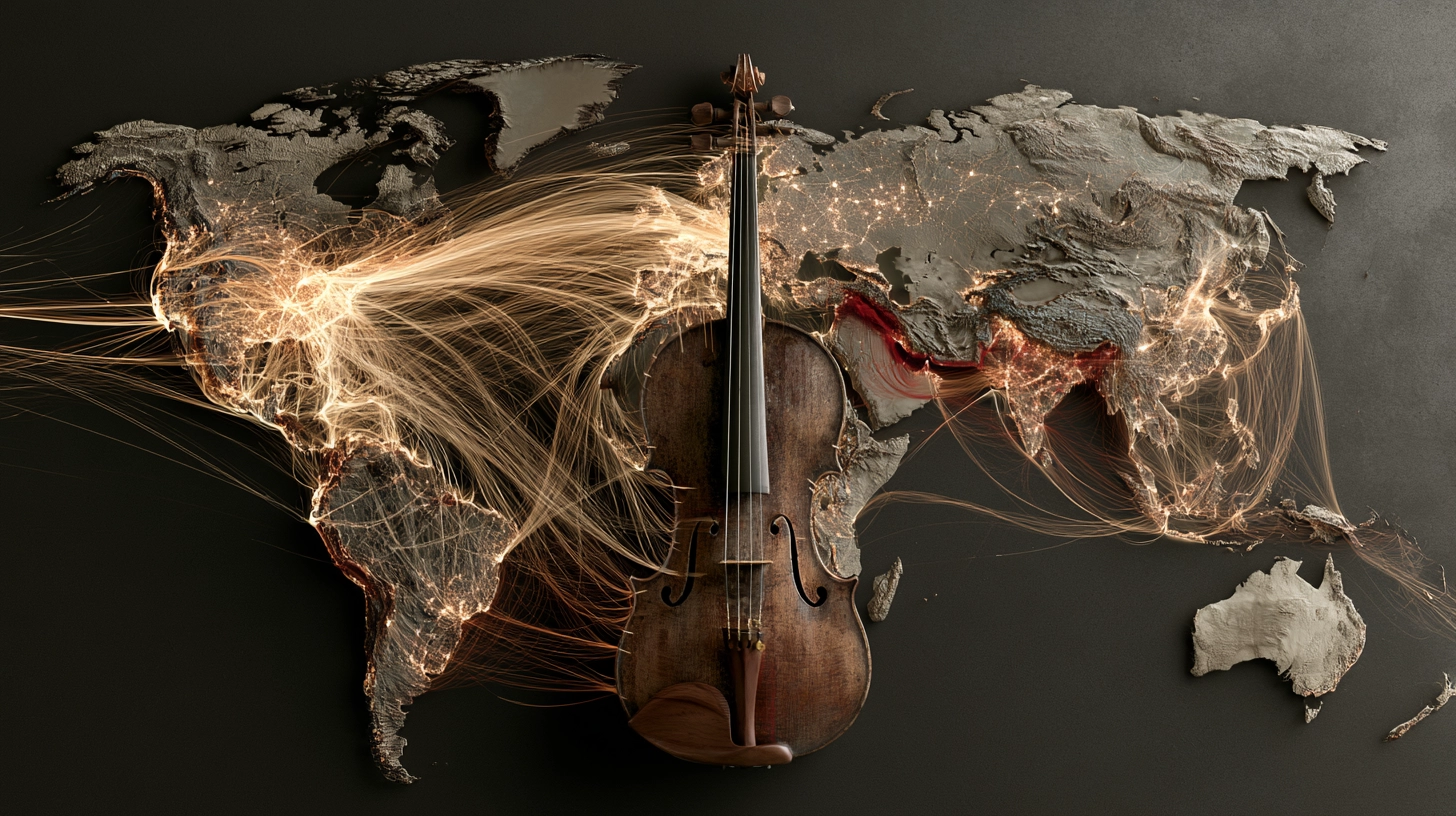
A violin competition draws 200 candidates from South Korea and 3 from Italy; a double-bass one draws 45 from Germany and zero from Asia. It is not chance, it is cultural geography: every instrument has its world capitals, its secret nurseries, its migration routes. Across 230,375 competition entries, patterns emerge as clear as meridians and parallels.
The four string maps
- The golden triangle of the violin: Seoul-Shanghai-Tokyo, which produces 47% of major winners over the last 5 years. Not genetics, but system.
- The viola backbone: Germany-Czech Republic-Russia, where the middle register is culture and the orchestral tradition is strong.
- The cello axis: France (elegance), Russia (power), US East Coast (versatility).
- The double-bass islands: southern Germany, Vienna, a few US cities, where the bass is not a fallback but a choice.
The Korean violin paradox
In the database Korean violinists make up 31% of international entries, 43% of finalists and 52% of winners under 20. It is not innate talent, it is system: in Korea 400,000 children study violin seriously, social status is tied to children's musical success, average family investment is very high. The result? A 16-year-old Korean already has 15,000 hours of practice, against the 4,000 of a European of the same age.
If your violin competition does not draw Koreans, you are fishing in the second division.
The secret Germany of violas and basses
Why do 38% of the best violists and 44% of the best double-bassists come from Germany? Because of a unique orchestral culture: 133 professional orchestras (more than the USA, UK and France combined), a tradition that prizes the "Mittelstimmen" (middle voices), a Praktikum system that forms complete professionals, and the double bass seen not as a "big instrument" but as the foundation of harmony.
The practical consequences are sharp: a viola competition that does not advertise in Germany loses half the world's talent, and a double-bass one that ignores Vienna and Munich is destined for mediocrity. Geography, here, is not a detail — it is the very pool to fish from.
America of second chances
The USA has a hidden superpower: a university system that lets you start late. In the database 43% of American participants started their instrument after age 12, 67% changed instrument at least once, 89% combine music with another degree. The result is musicians technically less perfect but with creativity not crushed by the system, communication skills, "late bloomer" resilience and a powerful university network.
For competitions that value interpretation over technical perfection, the USA is a gold mine; for purely technical competitions, better to look elsewhere. It proves geography must be crossed with the competition's values.
Russia and Japan: technique and perfectionism
Post-1990 Russia became the biggest exporter of musical talent: Soviet system plus market economy equals a diaspora of excellence. Russians compete for Germany (34%), the USA (28%), Israel (19%), with impeccable technique and very high psychological resilience. But beware: often the best have already emigrated — looking for them in Moscow is too late, they are already in Berlin.
The Japan of perfectionism
It produces 19% of participants but only 7% of winners: maniacal preparation, absolute technical perfection, but terror of interpretive risk. Ideal for competitions that reward precision and reliability.
The Europe factor
There is a clear trend: Japanese who study in Europe for 2+ years combine Asian precision and European freedom, and win 31% more than average. Migration changes the candidate.
Latin America that surprises
Venezuela (El Sistema), Brazil, Argentina produce 6% of candidates but 14% of "memorable" finalists. They overperform thanks to the innate musicality of a rhythmic culture, El Sistema (a million Venezuelan children in orchestras), a hunger for social redemption and brave, never-dull interpretations. The limit is technical preparation often weaker, for lack of resources.
One competition began offering a "preparation grant" three months ahead for South Americans: from 2 to 34 Latin participants, 3 in the final. For those seeking "the next Dudamel", it is fertile ground.
Micro-targeting and the global calendar
Don't send the same message everywhere: each instrument/geography combination has its triggers. For Korean violinists, the international jury, past winners in careers, publication in Korean matter; for German violists, post-competition orchestral opportunities and timing (September-October); for double-bassists, everywhere, word of mouth and the ISB (International Society of Bassists) are THE channel, with a double-bassist on the jury obligatory.
When each geography decides
- Asia: in January, for the summer. Publishing in May to attract Asians means zero entries — they are already committed elsewhere.
- Europe: March-April for the summer, September for the winter.
- USA: continuous, with peaks at semester breaks.
- Russia: September is everything.
- Latin America: depends on available funds, not on the calendar.
The formula for the perfect mix
Targeted investment multiplies: translating the call into Korean costs €200 and brings 40 extra candidates; a scout in Moscow costs €1,000 and uncovers five future winners; partnership with El Sistema costs nothing but brings priceless energy. Competitions that invest in geographic targeting see +156% international entries and +89% average candidate quality. But you don't want only Koreans (perfect but similar), nor only Latins (charismatic but uneven): you want the mix that strikes sparks — about 30% Asia, 30% Eastern Europe, 20% Western Europe, 10% the Americas, 10% surprises.
When different musical cultures collide, magic moments are born. And magic moments create legendary competitions.
